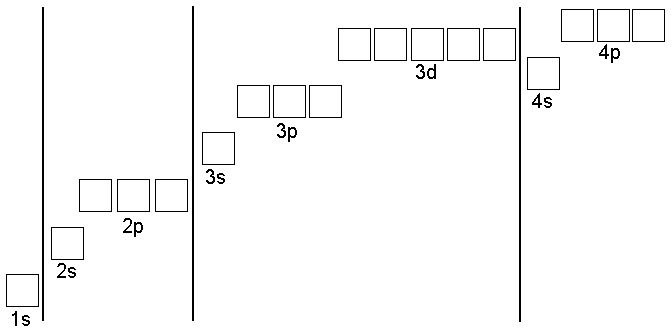
Fill the boxes below with the arrow notation for electrons
showing the correct ground state electron configuration for Al. To the right of the boxes, draw the Lewis Dot Diagram for neutral Al.
Write out the electron configuration in the short-hand
notation.
Fill the boxes below with the arrow notation for electrons
showing the correct ground state electron configuration for P. To the right of the boxes, draw the Lewis Dot Diagram for neutral P.
Write out the electron configuration in the short-hand
notation.
Fill the boxes below with the arrow notation for electrons
showing the correct ground state electron configuration for Br. To the right of the boxes, draw the Lewis Dot Diagram for neutral Br.
Write out the electron configuration in the short-hand
notation.
page break
Write out the shorthand notation for the electron configuration of Li, Na, and K.
Write out the shorthand notation for the electron configuration of C, Si, and Ge.
Write out the shorthand notation for the electron configuration of Be, Mg, and Ca.
Write out the shorthand notation for the electron configuration of B, Al, and Ga.
Each group of atoms in the previous several problems has something in common with other atoms in the same group. What is it?
How do you write the electron configuration for an ion?
Write out the shorthand notation for the electron configuration of O2–, F–, Ne, and Na+.
What do the electron configurations in the previous problem have in common with each other?
The electron configuration of Neon (Ne) is particularly stable. Using this fact, explain why the ions of oxygen, fluorine, and sodium have the charges shown in the problem above.
Which shell of an atom is the most important shell when you want to know something about how an element will react chemically? Why?
What orbitals are allowed in principal quantum numbers 1, 2, 3, and 4?
How does the Aufbau Principle work?
What is Hund’s Rule?
What is the Pauli Exclusion Principle?
Walter White, the main character of the TV show Breaking Bad, is a chemistry teacher who cooks methamphetamine to make money for his family when he finds he is dying of lung cancer. Why did he use the name Heisenberg when he chose a name to hide his identity?